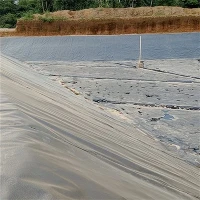
Construction Preparation Stage
Material Preparation:
Firstly, select geotextiles of appropriate specifications according to the design requirements of the dam. The specifications of geotextiles include parameters such as mass per unit area, thickness, and tensile strength. For example, for the slopes of large dams that bear relatively high water pressure, geotextiles with higher strength and greater thickness need to be selected to ensure their anti-seepage and anti-puncture performance.
Check the quality of geotextiles to ensure that there are no damages, holes or flaws. The materials should have good chemical corrosion resistance, aging resistance and other properties to adapt to the complex environment where the dam is located.
Site Preparation:
Clean the surface of the dam slope and remove debris such as weeds, tree roots and stones. The slope surface should be flat, and the uneven parts should be trimmed. The flatness error is generally controlled within ±5cm.
Properly compact the slope, and the degree of compaction should meet the design requirements, usually not less than 90%, so as to provide a stable foundation and prevent the geotextiles from being damaged due to uneven settlement of the foundation after laying.
Laying Process
Laying Sequence:
The laying of geotextiles should start from the bottom of the dam slope and proceed from bottom to top. This can avoid the upper geotextiles from pulling and displacing the lower ones that have already been laid during the laying process.
Splicing Methods:
When geotextiles need to be spliced, there are several splicing methods available. For the sewing method, a special sewing machine should be used for sewing. The sewing thread should be made of materials that are the same as or compatible with the geotextile material, and the sewing strength should meet the requirements. Generally, the sewing strength should not be less than 70% of the strength of the geotextile itself. The sewing stitch spacing should be appropriate, usually controlled between 5 - 10mm to ensure that the splicing parts are tight and firm and prevent leakage.
The heat-bonding method is also a commonly used splicing method. Utilize the thermoplasticity of the geotextile material and bond them together by heating. During the heat-bonding process, the temperature and pressure should be well controlled. The temperature is generally between 180 - 220 °C, and the pressure depends on the material and thickness of the geotextile, usually between 0.3 - 0.5 MPa to ensure firm bonding.
Fixing Measures:
During the laying process of geotextiles, they need to be fixed to prevent sliding. The anchoring trench fixing method can be adopted. Excavate anchoring trenches at the top and bottom of the dam slope. The depth of the trench is generally 30 - 50cm. Put the edges of the geotextiles into the anchoring trenches and then backfill and compact with soil.
The U-shaped nail fixing method can also be used. The length of the U-shaped nail is generally 20 - 30cm, and the spacing is determined according to factors such as the tension of the geotextile and the slope gradient, usually between 1 - 2m. Drive the U-shaped nails vertically into the slope to fix the geotextiles on the slope surface.
Inspection and Acceptance after Laying
Appearance Inspection:
Check whether the geotextiles are laid flat and whether there are wrinkles or folds. If there are wrinkles, it may lead to local stress concentration and affect the anti-seepage performance and service life of the geotextiles. The height of the wrinkles should generally not exceed 5cm. For wrinkles exceeding the specified limit, they should be re-laid or adjusted.
Check whether the splicing parts are firm and whether there are cracks, debonding and other situations. The width error of the splicing parts should be controlled within ±1cm.
Performance Testing:
The anti-seepage performance of geotextiles can be tested by means of on-site sampling inspection. For example, through the water injection test, set a certain height of water layer above the geotextiles and observe whether there is leakage under the geotextiles within a certain period of time (such as 24 - 48 hours) to verify whether the anti-seepage effect of the geotextiles meets the design requirements.