

Geocell
With more than 18 years of industry experience, we take professionalism, innovation and excellent quality as our creed, and are committed to providing customers with excellent geomembranes, geotextiles and other geosynthetic materials products. Through advanced production technology, rich experience and unremitting innovation, we provide the best geotechnical material solutions for engineering and construction projects in various industries around the world.
Advanced Materials
We manufacture custom geomembrane liners made from reinforced polyethylene (RPE), reinforced polypropylene (RPP) and low density polyethylene (LDPE). Our RPE and RPP liners are stronger, provide better puncture and tear resistance, are lighter weight and have excellent UV resistance when exposed to sunlight.
Reliable Quality Control
The company has established a national-standard laboratory for in-house quality control. We built a strict quality control system in all aspects from raw materials testing,production processes to final product quality testing.
Professional Experience
We has more than 18 years experience of geotextiles production in geosynthetic products, including geomembrane, geotextile, HDPE geomembrane, geocell, 3D geomat and etc. We provide complete geosynthetic solutions for ground stabilization, reinforcement and drainage, erosion control, bank and slope protection.
Complete Qualifications
Our factory is certificated by ISO9001, ISO14001, and OHSAS18001. All geomembranes have passed the certificates of the TUV, Soncap, SASO, BV and the test of SGS and Intertek etc.
-
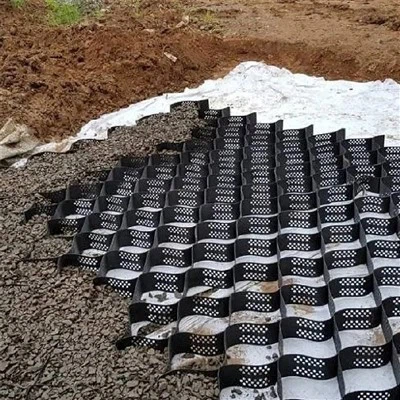 Geocell DrivewayGeocell Driveway systems revolutionize pavement stability, transforming loose gravel into durable, high-performance pavement. Our 3D honeycomb confinement technology locks aggregate in place,Add to Inquiry
 -
 Geocell Retaining WallWith their three-dimensional honeycomb design, Geocell retaining walls confine soil, aggregate, or other infill materials to create a stable, load-bearing structure that resists lateral earthAdd to Inquiry
 -
 Honeycomb GeocellHoneycomb Geocell represents the next generation of soil stabilization technology, utilizing a unique cellular confinement design to create high-performance reinforced structures. This innovativeAdd to Inquiry
 -
 Cellular GeocellCellular Geocell is a revolutionary geosynthetic material designed for superior soil stabilization, erosion control, and load support in various civil engineering and construction applications. MadeAdd to Inquiry
 -
 200mm Geocell GeogridThe 200mm Geocell Geogrid is an advanced cellular confinement system designed to enhance soil stabilization, erosion control, and load support in civil engineering and construction projects. ItsAdd to Inquiry
 -
 HDPE Plastic GeocellGeocell, Height: 50mm, 75mm, 100mm,125mm, 150mm ,200mm . Thickness: 1.1mm, 1.2mm, 1.4mm, 1.5mm. . Welding Distance:330-1000mm. Surface Textured Or Smooth.Add to Inquiry
 -
 HDPE Grid GeocellGeocells are three dimensional honeycombs of polymeric strips filled with granular material (sand, recycled asphalt, local soils). This cellular confinement system prevents movement of infill andAdd to Inquiry
 -
 Smooth HDPE GeocellGeocell refers to the Cellular Confinement System, which is an excellent geosynthetic erosion control system that confines the desired fill and resists downward migration of material due to hydraulicAdd to Inquiry
 -
 Geocell Erosion ControlGeocell is the ideal product for soil reinforcement. It can significantly improve bearing capacity thanks to its three-dimensional structure. In many scenarios (various roads, airstrips, containerAdd to Inquiry
 -
 Gravel Stabilizer GeocellGeocell, also known as a cellular confinement system, is a ground support system typically performed by civil engineers. Geocells exist because sometimes the ground isn't stable enough to be used forAdd to Inquiry
 -
 Smooth Perforated GeocellGeocell is a permeable 3D cellular soil confinement system used for erosion control on slopes. GEOCELL is supplied in pack and is expanded on-site to form the honeycomb-like structure.Add to Inquiry
 -
 Geocell Slope ProtectionGeocell is a three-dimensional cellular structure that can be filled with soil, gravel, or other materials to stabilize steep slopes and prevent erosion.Add to Inquiry


Brief Introduction to Geocell
Cellular confinement systems (CCS-also known as geocells-are widely used in construction for erosion control, soil stabilization on flat ground and steep slopes, channel protection, and structural reinforcement for load support and earth retention. Typical cellular confinement systems are geosynthetics made with ultrasonically welded high-density polyethylene (HDPE) strips or novel polymeric alloy (NPA)-and expanded on-site to form a honeycomb-like structure-and filled with sand, soil, rock, gravel or concrete.

Advantages of Geocell in Road Construction
Increased Load Bearing Capacity
The unique design of geocells allows them to mimic the soil structure and help increase the load-bearing capacity of roads. This is especially beneficial for roads that are located on softer soils, as they are more susceptible to deformation and damage without reinforcement.
Increased Road Strength and Durability
Geocells also help increase the strength of the road, thanks to their ability to spread loads over large areas. The cells help contain road aggregates and reduce the likelihood of rutting and other defects. This ensures that the road can withstand heavier loads.
Cost Savings
Road constructors can save on costs with geocells because less aggregate is needed for construction. The cells also make it possible to construct roads quickly, with fewer construction materials and personnel. This means that costs can be reduced.
Faster Road Construction
Thanks to the form and function of geocells, road construction can be completed faster. This is because the cells reduce the amount of time needed to lay down aggregate and the amount of time needed to finish the road. This makes it possible to complete projects more quickly and efficiently.
Improved Drainage
Geocells can also help improve the drainage of roads, allowing water to drain away from the surface quickly. This helps reduce the risk of flooding and the potential for damage to the road structure.
Geogrid Features
A geogrid is a flat, planar material made from polymer materials like polyester, polypropylene, and high-density polyethylene (HDPE). Geogrid has high tensile strength, which means it can withstand heavy loads and external pressure before it breaks down. Geogrids protect against deformation small creep corrosion. In other words, it is creep and corrosion-resistant, which means it can keep its shape for an extended period of time and is resistant to chemical damage. Small creep corrosion resistance is a major benefit for roadway and retaining wall construction.


Geocell Features
Geocell is a three-dimensional structure made from HDPE. It has interconnected cells that make the geocell look like a honeycomb. The open cells can be filled with materials such as soil, gravel, or even concrete. It compacts the soft soil and sediment within the cells, keeping the ground from shifing underneath and providing reinforcement. Because geocells are made with flexible materials, it conforms to the soil easily, Geocells are high-density products which mean they are durable and can withstand heavy loads.
Benefits of Geocells
Geocells are used to protect slopes from erosion and help stabilize the surface. The cells conform to the terrain and create a three-dimensional wall that prevents soil particles from moving laterally. This helps prevent landslides and keeps the slope stable. In addition, geocells reduce the amount of material required to stabilize a slope, which saves time and money. They can also be installed quickly and easily, without the need for heavy equipment. Geocells are widely used in road construction to prevent erosion on steep grounds. In one project, a crew of four people was able to install over 11,000 square meters of geocellular reinforcement in just two days. Erosion is not only a problem on steep slopes. It can also occur on flat surfaces, like roads and parking lots. In these cases, geocells can be used to create a textured surface that helps prevent the loss of material due to wind and water erosion. Geocells are often used in conjunction with other stabilization methods, such as gabions, check dams, and retaining walls. When combined with these methods, geocells provide even greater stability and protection from erosion.
Geocells are also used as protective linings for channels and other hydraulic structures. The cells form a three-dimensional wall that prevents soil particles from entering the waterway and causing pollution.In addition, the cells help reduce the erosion of the channel bed and sides. This extends the life of the structure and helps keep it in working order. Channel linings made with geocells are also less likely to clog, which can lead to flooding. The smooth walls of non-perforated geocells prevent dirt and debris from building up on the surface, while perforated geocells allow water to flow through, removing any buildup that does occur. Geocells have been used to line over 100 kilometers of channels in Europe alone. Channel linings are not the only application for geocells in hydraulic structures. They can also be used as a protective layer beneath riprap, gabions, and other stabilization methods. This helps prevent the erosion of the underlying soil and extends the life of the structure. In short, geocells offer many benefits that make them an ideal solution for slope stabilization and protection from erosion.
Geocells are also used to support static and dynamic loads on weak subgrade soils. The cells create a three-dimensional grid that distributes the load over a larger area, which helps prevent soil failure. In addition, the perforations in the strips allow water to flow through, which helps keep the soil moist and prevents it from becoming compacted. This increases the stability of the soil and reduces the risk of failure. Geocells are an effective way to support heavy loads on weak soils. In one project, they were able to support a load of up to 400 kilograms per square meter without causing any damage to the underlying soil. The use of geocells can help reduce costs by preventing expensive repairs or replacements of failed subgrade soils. In addition, they can be installed quickly and easily, without the need for heavy equipment. Geocells are a versatile solution that can be used in several applications to stabilize slopes and support loads on weak soils.
Geocells can also be used to create multi-layered earth-retaining and water-retaining gravity structures. The cells form a three-dimensional grid that helps distribute the load over a larger area, which reduces the risk of failure. In addition, the perforations in the strips allow water to flow through, which helps keep the soil moist and prevents it from becoming compacted. This increases the stability of the soil and reduces the risk of failure. Multi-layered structures made with geocells are an effective way to retain earth and water. In one project, they were able to retain up to 900 liters of water per square meter without causing any damage to the underlying soil. Geocells are a versatile solution that can be used in several applications to stabilize slopes and retain earth and water.
Geocells are widely utilized in civil engineering for road and pavement construction because they provide a flexible basis while keeping the soil intact. They prevent most of the stress cracking that happens in paved roads due to their greater load distribution capabilities. In addition, they help to keep the surface level by adjusting to thermal expansion and contraction. This extends the life of the pavement and reduces the need for repairs. Geocells have also been used in airport runway construction because of their ability to bear heavy loads without damage. The cells distribute weight evenly over a large area, which prevents cracking and increases the lifespan of the runway. Geocells provide many benefits that make them an ideal solution for road and pavement construction. They are flexible, durable, and able to bear heavy loads without damage. In addition, they help reduce stress cracking and maintain surface levels. Geocells have been used in airport runway construction with great success, making them a versatile option for many applications.
Even on steep slopes, a geocell grid is a more durable alternative to stone pitching or mulch matting. It keeps the soil from eroding without the need for pricey supplies or professional work. The cells form a three-dimensional grid that helps distribute the load over a larger area, which reduces the risk of failure. In addition, the perforations in the strips allow water to flow through, which helps keep the soil moist and prevents it from becoming compacted. This increases the stability of the soil and reduces the risk of failure. The cells are filled with soil and vegetation, which helps to further stabilize the slope. In addition, the roots of the plants help to anchor the soil in place. Slope protection is not only important for preventing erosion. It can also be used to create a more aesthetically pleasing landscape. With geocells, you can have a stable slope without sacrificing beauty.
A cellular confinement system is an environmentally acceptable approach to construct green slopes or retaining wall systems. Without considerable quarrying, the geocells can be filled with plants, concrete, or locally obtained materials such as dirt or gravel. Using locally produced products has a greater beneficial impact on the environment since it reduces your carbon footprint. Today, environmental friendliness is a top priority. Geocells offer a green solution that is environmentally friendly and sustainable.
Which Projects Will be the Geotextile Used for?


Treatment of Semi-filled and Semi-excavated Subgrades
When building an embankment on a slope whose natural slope is steeper than 1:5, the base of the embankment should be dug with steps, and the width of the steps should not be less than 1M. When excavating steps, the width of high-grade highway steps is generally 2M. Geocells are laid on the level surface of each layer of steps, and the geocell’s own façade reinforcement effect is used to better solve the problem of uneven subsidence.
Subgrade in a Sandy Area
The subgrade in the sandy area should be a low embankment, and the filling height is generally not less than 0.3M. Due to the professional requirements of low subgrade and heavy load for the subgrade construction in the sandy area, the use of geocells can limit the loose filler. The guaranteed subgrade has high stiffness and strength within a limited height to withstand the load stress of large vehicles.
Reinforcement of Backfill Roadbed
The use of geocells can better achieve the purpose of reinforcement on the back of the platform. Enough friction can be generated between the geocells and the filler, which can reduce the uneven settlement between the subgrade and the structure, and finally can ease the “abutment jumping”. Early impact damage to the bridge deck due to “car” disease.
Subgrade in Permafrost Areas
When building fills subgrades in permafrost areas, the smallest fill height should be reached to prevent the occurrence of slurry churn or the lowering of the upper limit of the frozen layer, resulting in excessive settlement of the embankment. The unique façade reinforcement effect of the geocell and the confinement of the effective implementation can ensure the smallest filling height in some special sections to the greatest extent, and make the filling have high-quality strength and rigidity.
Loess Collapsible Subgrade Treatment
When expressways and first-class highways pass through collapsible losses with good compressibility, or when the allowable bearing capacity of the foundation of a high embankment is lower than the pressure of the cooperative load of vehicles and the self-weight of the embankment, the embankment will also be adjusted according to the bearing capacity requirements. Now, the superiority of the geocell is manifested.
Saline Soil, Expansive Soil
The highways, first-class highways, road shoulders, and slopes built with saline soil and expansive soil adopt reinforcement measures. The facade reinforcement effect of the cell is the most excellent of all reinforcement materials, and it has excellent corrosion resistance. It can meet the requirements of building high-grade highways in saline soil and expansive soil.
Ultimate FAQ Guide to Geocell
Q: How is the cellular confinement system produced?
Q: How does geocell work?
Q: Why Is It Important to Use Geocell?
Q: What are the common applications of cellular confinement systems?
Slope Erosion Control: When working on sloped terrain, erosion control is always a central concern. When the soil starts to erode, the structural integrity of the ground weakens, creating an unsafe foundation to work on. Cellular confinement systems are often utilized to reinforce the foundation. These systems solidify a job site’s foundation promoting vegetative growth, which further reinforces the soil. With this added strength to the foundation, slopes with angles up to 70° can resist erosion.
Retaining Walls: On so many construction sites, rough terrain and slopes create the need for retaining wall structures. Changes in elevation and uneven terrain create problems for construction projects that require flat, graded land. Retaining walls allow the land to be graded and secured from erosion or potential collapse. Sometimes steel-reinforced concrete walls are used to create retaining walls but that method is expensive, can harm the environment, and can potentially crack in high-stress situations. Cellular confinement systems are a cost-effective alternative for creating durable, eco-friendly, and flexible retaining walls. Vegetation can flourish through the permeable walls, increasing their structural integrity and aesthetics.
Channel Wall Protection: Channels are especially prone to erosion because of the constant flow of water. This erosion of soil particles causes them to enter the nearby waterway, increasing the turbidity of the water and harming local wildlife. In addition to environmental concerns, uncontrolled erosion on channel walls can compromise the integrity of the entire system and potentially cause it to fail. Channel walls must be flexible enough to adapt to tidal and seasonal changes, but stable enough to resist intense hydraulic stresses. Cellular confinement systems offer an effective solution. Supporting channel walls with these systems allows for a strong but flexible channel wall that can drain naturally.
Q: What are the different types of geocells?
Q: Are geocells worth it?
Q: What is the disadvantage of Geocell?
Q: What are plastic geocells used for?
Q: What is the lifespan of a Geocell?
Q: Can you fill geocell with concrete?
Q: What is the difference between geogrid and Geocell?
Q: What is the difference between Geocell and Geoweb?
Q: Where is Geocell used?
Q: What is the infill material for geocell?
Q: What is a Geocell driveway?
Q: How thick is a geocell?
Q: How is Geocell made?
Q: What is the difference between Geocell and concrete?
Q: Can you stack Geocells?
Q: What is a geocell for slope protection?
We're professional geocell manufacturers and suppliers in China, specialized in providing high quality products with low price. We warmly welcome you to buy geocell for sale here from our factory.
Geocomposite Drainage Membrane, Landfill Geomembrane, Ldpe Geomembrane Liner