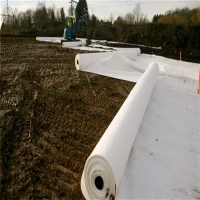
Preparations Before Construction
Site Clearance
Thoroughly clean the construction site of the tailings pond and remove sharp objects on the site, such as branches, stones, etc. These sharp objects may puncture the geomembrane during the laying process and affect its functions like anti-seepage.
Properly level the uneven surface of the site to ensure that the slope of the site meets the design requirements. Generally speaking, the flatness requirement for the bottom of the tailings pond is relatively high, and the height difference should be controlled within the allowable range. For example, the allowable local unevenness should preferably be controlled within ±2cm.
Material Inspection
Inspect the quality of the geomembrane, including checking whether the product specifications meet the design requirements. For example, check the thickness of the geomembrane (generally, the thickness of the geomembrane used for tailings treatment is between 0.5 - 2.0mm), the material (HDPE geomembrane is commonly used), etc.
Check whether the appearance of the geomembrane has defects such as damages or holes. Conduct sampling inspections on each roll of the geomembrane. The inspection ratio is determined according to the project requirements and material batches. For example, it can be carried out by sampling one roll out of every 10 rolls. Meanwhile, also check whether the physical performance indicators of the geomembrane, such as tensile strength and elongation at break, meet the design requirements. These indicators are related to the anti-deformation ability of the geomembrane during its use.
Laying of Geomembrane
Weather Conditions
Avoid laying the geomembrane under adverse weather conditions, such as rainy or windy days. Rainwater will make the site muddy, affecting the adhesion between the geomembrane and the base, and may also contaminate the geomembrane with impurities such as soil, affecting its anti-seepage performance. Windy weather may blow the geomembrane, resulting in uneven laying or difficulties in splicing.
Temperature is also a factor that needs to be considered. When the temperature is too low, the geomembrane material will become brittle and is prone to cracking during the laying process. Therefore, the construction temperature is generally preferably above 5 °C.
Laying Method
The laying of the geomembrane should start from the bottom and be laid upward along the slope. During the laying process, ensure that the slackness of the geomembrane is moderate, avoiding being too tight or too loose. If it is too tight, it may cause the geomembrane to rupture when the foundation settles or tailings accumulate. If it is too loose, wrinkles will occur, affecting the anti-seepage effect. Generally, the slackness of the geomembrane is required to be around 2 - 5%.
The overlapping width between adjacent geomembranes should meet the design requirements, usually not less than 10cm, and ensure that the overlapping parts are closely attached. They can be connected by methods such as heat welding or bonding with adhesives. When heat welding, pay attention to the control of welding temperature and speed. The welding temperature is generally between 200 - 300 °C, and the welding speed varies according to the thickness of the material and the welding equipment. For example, for a 1.0mm thick geomembrane, the welding speed can be controlled between 0.2 - 0.5m/min.
For complex terrains, such as slopes and corners, the geomembrane should be properly cut and spliced to ensure that it closely fits the terrain. When laying on the slope, pay attention to the anti-slip of the geomembrane. Measures such as setting anti-slip nails or anti-slip grooves can be taken to enhance the stability of the geomembrane on the slope.
Welding and Sewing
Welding Quality Control
Before welding, debug the welding equipment to ensure that parameters such as welding temperature, pressure and speed meet the requirements. During the welding process, ensure the continuity and flatness of the weld, and avoid situations such as missed welding and false welding.
After welding is completed, conduct quality inspections on the weld. Methods such as air pressure testing or vacuum testing can be adopted. When conducting air pressure testing, generally inflate the inside of the weld to a pressure of 0.15 - 0.2MPa and maintain it for 1 - 5 minutes. Observe whether the pressure drops. If the pressure drop does not exceed the specified value (such as 10%), the weld is qualified. Vacuum testing involves placing a vacuum box on the weld and judging whether there is air leakage in the weld by observing the reading of the vacuum gauge.
Sewing Requirements
If the geomembrane is connected by sewing, use high-quality sewing threads, generally high-strength polyester fiber threads. The sewing stitch spacing should be uniform, generally controlled between 3 - 6mm, and ensure that the sewing is firm to avoid the sewing part from splitting during use.
Inspection After Construction
Overall Inspection
After the construction is completed, conduct a comprehensive inspection on the entire area where the geomembrane is laid. Check whether there are problems such as damages, holes, or wrinkles on the surface of the geomembrane. If small damages or holes are found, repair them in a timely manner using repair materials (such as special repair glue or patches for geomembrane).
Check whether the splicing parts and welds of the geomembrane are firm. Re-inspect the parts in doubt. Meanwhile, also check whether the connection between the geomembrane and the surrounding fixed structures (such as the concrete foundation of the tailings dam) is tight.
Construction of Protective Layer
After confirming that the construction quality of the geomembrane is qualified, conduct the construction of the protective layer in a timely manner. The protective layer can be made of materials such as soil or sand and gravel. Its thickness is generally determined according to the engineering design requirements. For example, the thickness of the soil protective layer can be between 30 - 50cm. The role of the protective layer is to prevent the geomembrane from being damaged by external forces, such as the impact of tailings and the rolling of machinery. During the construction of the protective layer, pay attention to avoiding direct contact between construction machinery and the geomembrane to prevent damage to the geomembrane.