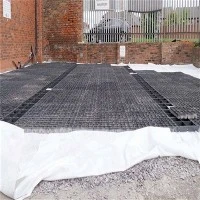
Base Surface Treatment: Ensure that the laying base surface is solid and flat. There should be no sundries such as tree roots, rubble, and stones within a vertical depth of 25 cm that may damage the geomembrane. For the ground with cracks and potholes, it should be repaired. The corners of the base should be rounded, and the radius of the arc generally should not be less than 500 mm.
Material Inspection: Carefully inspect the quality of the geomembrane, check for any defects such as damage, holes, and scratches, and ensure that the indicators such as the size, thickness, and physical properties of the geomembrane meet the design requirements. At the same time, check whether the quantity of materials meets the construction requirements.
Confirmation of Construction Environment: Try to choose a weather with an air temperature above 5°C, wind force below level 4, and no rain or snow for laying. If construction must be carried out in a special environment, such as a low-temperature environment, thermal insulation measures need to be taken; in windy weather, there should be wind-proof measures such as temporary anchoring.
Preparation of Tools and Equipment: Prepare the tools and equipment required for laying, such as heat welding machines, cutting tools, measuring tools, roller compactors, etc., and ensure that their performance is good and they can be used normally.
Laying Process
Laying Direction and Sequence: Reasonably select the laying direction to minimize the stress on the joints as much as possible. There should be no transverse joints on the slope surface with a slope greater than 10% and within a range of 1.5 m from the toe of the slope. Generally, it is carried out from one end to the other end, laying the end part first and then the middle part.
Laying Tightness: When laying the geomembrane, it should not be stretched too tightly. The parts buried in the soil at both ends should preferably be in a corrugated shape. Especially when anchored to rigid materials, a certain amount of expansion and contraction should be reserved to avoid the geomembrane from being torn due to factors such as temperature changes or foundation settlement.
Avoiding Damage: During the laying process, prevent the geomembrane from being scratched or punctured by sharp objects, such as stones and steel bar heads on the site. Construction personnel should wear soft-soled shoes, and it is strictly prohibited to step on the geomembrane or perform operations that may damage the geomembrane.
Lap Treatment: Determine an appropriate lap width, generally 0.3 m - 0.9 m. The lap joint should be flat without wrinkles to ensure that the two layers of the geomembrane fit closely.
Joint Treatment
Preparation before Welding: When using the heat welding method, before welding, clean the dust, oil stains, etc. on the surface of the joint, and adjust the two sides of the PE single film at the joint to make the lap joint flat.
Control of Welding Parameters: Reasonably adjust the parameters such as welding temperature, speed, and pressure according to factors such as the material and thickness of the geomembrane. For example, when welding the PE film, the temperature is generally controlled at 250°C - 300°C, and the walking speed is generally 1 - 2 m/min.
Welding Quality Inspection: Check the quality of the weld seam at any time during the welding process to check for any defects such as missed welding, poor welding, and bubbles. After the welding is completed, sample and test the weld seam at the specified frequency, such as using the air pressure leak detection method, vacuum test, or spark test.
Protection after Laying
Timely Covering: After the laying is completed, the protective layer, such as fine sand, clay, concrete slabs, etc., should be covered as soon as possible to avoid the geomembrane from being exposed to the sun for a long time and prevent the acceleration of its aging due to ultraviolet radiation.
Preventing Man-made Damage: When carrying out subsequent construction above the geomembrane, protective measures should be taken to prevent construction machinery, tools, etc. from damaging the geomembrane. It is prohibited to carry out operations that may damage the membrane body on the laid geomembrane.
Leakage Detection: After the construction of the protective layer is completed, leakage detection can be carried out, such as using the water injection test method to check the anti-seepage performance of the geomembrane. If a leakage point is found, it should be marked in a timely manner and repaired.
分享
在翻译文本中加入"铺设过程"的注意事项