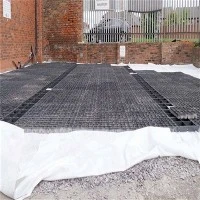
Geotextiles play an important role in the anti-seepage of earth-rock dams. The following is a detailed introduction:
Application Forms
As an anti-seepage inclined wall: Geotextiles are laid on the upstream slope of the earth-rock dam to form a continuous anti-seepage inclined wall, which can effectively prevent water from seeping into the dam body through the surface. For example, in some small earth-rock dams, the use of geotextile inclined walls for anti-seepage is simple in construction and has a good effect.
As an anti-seepage core wall: It is located in the middle of the earth-rock dam body and is set perpendicular to the dam axis. The geotextile core wall can cut off the seepage channels inside the dam body and enhance the anti-seepage performance of the dam. For earth-rock dams with a highly permeable dam foundation, the use of a geotextile core wall for anti-seepage can significantly improve the stability of the dam body.
Combined with other materials: Geotextiles are often combined with materials such as geomembranes and sand cushions to form a composite anti-seepage structure. The geomembrane provides the main anti-seepage function, while the geotextile plays auxiliary roles such as protecting the geomembrane, increasing the friction coefficient, and draining, jointly improving the reliability and stability of the anti-seepage system.
Advantages
Good anti-seepage effect: Geotextiles have a low permeability coefficient, which can effectively block the passage of water, reduce the seepage volume of the dam body, and ensure the water storage function of the earth-rock dam.
Strong ability to adapt to deformation: Geotextiles have good flexibility and ductility, and can adapt to uneven settlement and deformation that may occur during the construction and operation of the earth-rock dam. They are not easy to crack or be damaged due to dam body deformation, thus always maintaining good anti-seepage performance.
Simple and quick construction: Geotextiles are lightweight and have a large width. The laying construction is relatively simple, which can greatly shorten the construction period and reduce the construction cost. At the same time, the construction process is less affected by natural conditions such as weather, and can be carried out in a relatively complex construction environment.
Good environmental performance: The materials generally have good corrosion resistance and aging resistance, are not easy to pollute the surrounding environment, and can protect the ecological environment around the dam body to a certain extent, which is conducive to soil and water conservation and ecological balance.
Construction Key Points
Dam foundation treatment: Before laying geotextiles, the dam foundation needs to be leveled, compacted, etc. to ensure that the dam foundation surface is solid and flat without sharp objects, so as to avoid puncturing the geotextiles and affecting the anti-seepage effect.
Geotextile laying: When laying, the geotextiles should be kept flat and straight, and phenomena such as wrinkles and twists should be avoided. Effective splicing is required between adjacent geotextiles. Common splicing methods include sewing, welding, and bonding. The splicing quality is directly related to the integrity and reliability of the anti-seepage effect.
Anchoring and protection: The edges and ends of the geotextiles need to be properly anchored to prevent displacement or being lifted under the action of water flow. At the same time, an appropriate protective layer, such as concrete slabs and rubble, needs to be set on the surface of the geotextiles to protect the geotextiles from external factors such as ultraviolet radiation, water flow scouring, and animal damage.