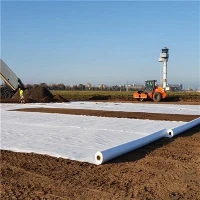
Beneath our roads, surrounding our landfills, and lining our drainage ditches lies an unsung hero of modern engineering: the nonwoven geotextile. This synthetic fabric, often mistaken for simple cloth, is a high-tech material that plays a critical role in ensuring the stability and longevity of countless structures we rely on every day. Let's explore what it is and how it works.
What Exactly is a Nonwoven Geotextile?
Imagine taking millions of tiny plastic fibers (usually polypropylene or polyester) and bonding them together randomly into a durable, felt-like fabric. That's essentially a nonwoven geotextile. Unlike woven textiles with their orderly patterns, this random structure creates billions of tiny pores, making it strong, flexible, and permeable-perfect for interacting with soil and water.
Why Do We Use It? The Four Key Superpowers
Geotextiles are deployed for four primary functions, often performing several at once:
Separation: This is its most common job. Imagine a gravel road built on soft clay soil. Over time, traffic would push the gravel down and mix the soil up, creating a muddy, weak mess. A geotextile placed between the soil and the gravel acts as a robust barrier, keeping the layers distinct and maintaining the road's strength.
Filtration: In drainage applications, like around perforated pipes (French drains) or behind retaining walls, water needs to escape while the soil must stay in place. The geotextile's porous structure allows water to flow through freely while filtering out soil particles, preventing clogging and erosion.
Drainage: The fabric itself can act as a conduit for water. The tiny gaps between its fibers create a network of passages that can transport water laterally within its plane, helping to relieve water pressure-a crucial function in earthworks and landscaping.
Protection: Perhaps its most delicate role is as a protective cushion. In landfills, a delicate waterproof liner (geomembrane) contains hazardous waste. A layer of nonwoven geotextile placed on top protects this liner from being punctured by sharp rocks in the overlying debris.
The Magic is in the Material
The choice of plastic-primarily polypropylene-is no accident. This material offers crucial advantages:
High Strength: It can withstand significant mechanical stress during installation and under load.
Durability: It is resistant to rot, mildew, and chemical degradation from soils and water, ensuring a long service life.
Consistency: Being a manufactured product, its properties are consistent and predictable, unlike natural materials which can vary.
From Roll to Role: A Peek at Installation
While proper installation is a science, the basic process is straightforward:
The ground is cleared and smoothed.
Large rolls of the fabric are unrolled flat onto the soil.
Adjacent rolls are overlapped by a specific amount (often 1-2 feet) to ensure a continuous barrier without gaps.
The critical step: the first layer of soil or aggregate is placed gently by machinery to avoid tearing the exposed fabric. Once buried under a protective layer, heavier equipment can complete the job.
Conclusion: The Fabric of Modern Infrastructure
Nonwoven geotextiles are a brilliant example of engineering innovation solving fundamental problems. They are a lightweight, cost-effective, and incredibly effective solution that strengthens the very ground beneath our feet. The next time you drive on a smooth road or see a stable slope on a rainy day, remember the unseen geotextile working tirelessly below, proving that sometimes the strongest foundations are, quite literally, built on fabric.