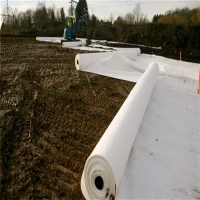
Key Steps:
Subgrade Preparation
Level and compact the foundation, ensuring no sharp protrusions or debris.
For soft soil, use a sand/gravel cushion (≥30 cm) for added stability.
Material Deployment
Unroll the filament PP geotextile (woven or non-woven) along the design axis.
Maintain proper tension; avoid folds or excessive stretching.
Overlap & Joining
Lap Joint: Overlap edges by 50–100 cm (subject to design requirements).
Seaming: Use thermal bonding (hot wedge welder) or sewing for high-strength applications.
Anchoring
Secure edges with U-shaped pins or sandbags (especially on slopes).
For exposed installations, temporary cover (e.g., soil/gravel) is recommended.
Protection & Backfilling
Immediately cover with fill material (e.g., soil/aggregate) to prevent UV degradation.
Use lightweight machinery to avoid fabric damage during compaction.
Technical Specifications:
Material: Filament-type polypropylene (PP) geotextile (high tensile strength, puncture-resistant).
Functions: Reinforcement, separation, filtration (e.g., roadbeds, landfills, embankments).
Standards: ASTM D5261 (tensile strength), ISO 10318 (geotextile classification).
Additional Notes:
For slope applications, install from bottom to top to minimize slippage.
Avoid prolonged UV exposure (max 7 days unprotected per ASTM D4355).
Let me know if you need details on testing methods (e.g., CBR puncture resistance) or slope-specific techniques!