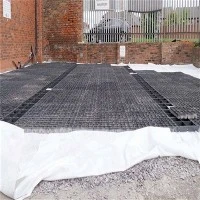
Anti-seepage Principle
Preventing water infiltration: Geotextiles themselves have extremely low permeability. Their tiny pores can effectively block the passage of water molecules, thus reducing the seepage of water from the slope soil and preventing the water inside the dam from leaking outwards, ensuring the water storage function of the dam.
Filtration function: While allowing water to pass through, geotextiles can prevent the loss of soil particles and avoid the fine particles in the slope soil from being carried away due to water erosion, thus maintaining the structural stability of the slope soil and preventing the formation of slope collapses and seepage channels caused by soil erosion.
Application Methods
Surface laying: Geotextiles are directly laid on the surface of the dam slope to form a continuous anti-seepage layer. During laying, attention should be paid to the splicing and fixation of geotextiles to ensure that they closely adhere to the slope surface without wrinkles and holes. Common fixation methods include sewing, bonding or using fixing nails, etc., to prevent the geotextiles from shifting under the impact of water flow or other external forces.
Combination with other materials: Geotextiles can be used in combination with other anti-seepage materials such as geomembranes and concrete panels to form a composite anti-seepage structure. For example, laying geotextiles on the upper and lower surfaces of the geomembrane can not only protect the geomembrane from damage by external factors but also enhance the overall stability and anti-seepage performance of the composite structure. When combined with concrete panels, geotextiles can serve as a transition layer between the panels and the soil, playing a dual role of buffering and anti-seepage.
Functions and Advantages
Enhancing slope stability: By preventing soil erosion and reducing the impact of water pressure on the slope, geotextiles can significantly improve the stability of the dam slope, reduce the occurrence risks of geological disasters such as landslides and collapses, and extend the service life of the dam.
Strong adaptability to deformation: Geotextiles have a certain degree of flexibility and tensile strength and can adapt to the deformation of the slope under different working conditions, such as deformations caused by changes in water level and soil settlement, without easily breaking or losing their anti-seepage function.
Simple and fast construction: Compared with some traditional anti-seepage construction methods, the laying of geotextiles is relatively simple and does not require complicated construction equipment and techniques, which can effectively shorten the construction period and reduce construction costs.
Good environmental protection performance: Geotextiles are generally made of environmentally friendly materials such as high-molecular polymers, which are pollution-free to the environment. And they will not cause damage to the surrounding ecological environment during the use process, meeting the environmental protection requirements of modern water conservancy project construction.
Low maintenance cost: Due to the good durability and anti-aging performance of geotextiles, under normal use conditions, their maintenance cost is low. It is only necessary to conduct regular inspections and maintenance to ensure that their anti-seepage performance is not affected.