


Products Description of Biaxial geogrid

|
Property |
Test Method |
PP15-15 |
PP20-20 |
PP30-30 |
PP40-40 |
PP50-50 |
BX1100 |
BX1200 |
|
|
Ulimate tensile strength(kn/m) |
MD |
|
15 |
20 |
30 |
40 |
50 |
12.4 |
19.2 |
|
CD |
15 |
20 |
30 |
40 |
50 |
19.0 |
28.8 |
||
|
Elongation at max load (%) |
MD |
13 |
|||||||
|
CD |
13 |
||||||||
|
Tensile strength at 2% elongation(kn/m) |
MD |
6 |
7 |
11 |
14 |
18 |
4.1 |
6 |
|
|
CD |
6 |
7 |
11 |
14 |
18 |
6.6 |
9 |
||
|
Tensile strength at 5% elongation(kn/m) |
MD |
11 |
14 |
21 |
28 |
35 |
8.5 |
11.8 |
|
|
CD |
11 |
14 |
21 |
28 |
35 |
13.4 |
19.6 |
||
|
Minimum Carbon Black( %) |
2 |
||||||||
|
Mesh Size (mm) |
31*31 33*33 36*36 39*39 |
||||||||
|
Junction Efficiency( %) |
95 |
||||||||
|
Roll width(m) |
2/3/3.95/5/5.9 |
||||||||
|
Roll length(m) |
50/75/100 |
||||||||
Key Features & Benefit of Biaxial geogrid
✔ Excellent load distribution – Reduces roadbed stress.
01
✔ High tensile strength – Resists deformation under heavy loads.
02
✔ Cost-effective – Reduces construction costs by reducing aggregate thickness.
03
✔ Durable and long-lasting – Resistant to UV rays, chemicals, and biodegradation.
04
✔ Easy to install – Lightweight and flexible, it can be deployed quickly.
05
Applications of Biaxial geogrid
1. Road and Pavement Construction
Base reinforcement: Reduces rutting and extends pavement life.
Subgrade stabilization: Prevents differential settlement.
2. Railway ballast reinforcement
Enhances track stability and reduces maintenance frequency.

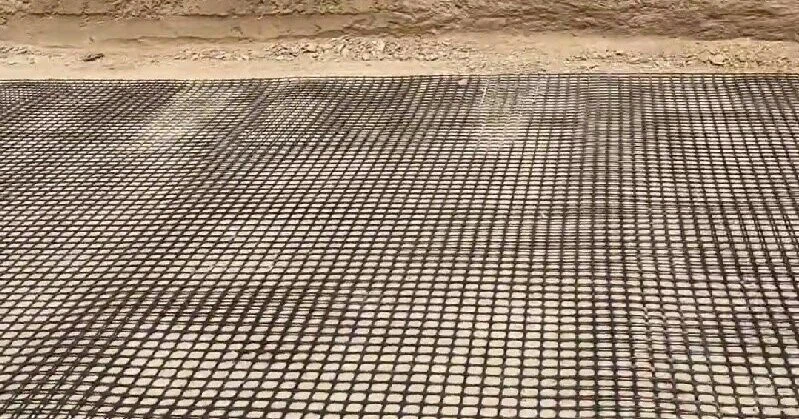
3. Embankments and Slopes
Prevents soil slippage and erosion on steep slopes.
4. Foundation support
Improves the bearing capacity of building and industrial floors.
FAQ
Q1: Can bidirectional geogrids be used under asphalt pavement?
A: Yes, but in asphalt pavement overlay applications, fiberglass geogrids are more suitable to prevent cracking.
Q2: How do bidirectional geogrids compare to unidirectional geogrids?
A: Bidirectional geogrids have equal strength in both directions, while unidirectional geogrids are better suited for unidirectional loads (e.g., retaining walls).
Q3: Do geogrid joints need to be welded?
A: No, lap joints and mechanical fasteners are sufficient for most applications.
Q4: What is the minimum subgrade bearing capacity ratio (CBR) for geogrid use?
A: Ideally, it should be ≥3%, but geogrids can provide reinforcement even in weak subgrades (CBR of 1-2%).
Q5: Can geogrids be recycled?
A: PP/PET geogrids can be recycled, but specific disposal procedures depend on local regulations.
Contact Information
Tai'an City Ruiheng Building Materials Co., Ltd
Address: NO.3566 Longquan Road, Tai'an Hi-tech Zone, Shandong Province, China
Website: www.rhgeos.com
Email: lorna@rhgeos.com
Phone / Whatsapp / Wechat: 0086 187 6669 7769
Hot Tags: biaxial geogrid, China biaxial geogrid manufacturers, suppliers, factory


