


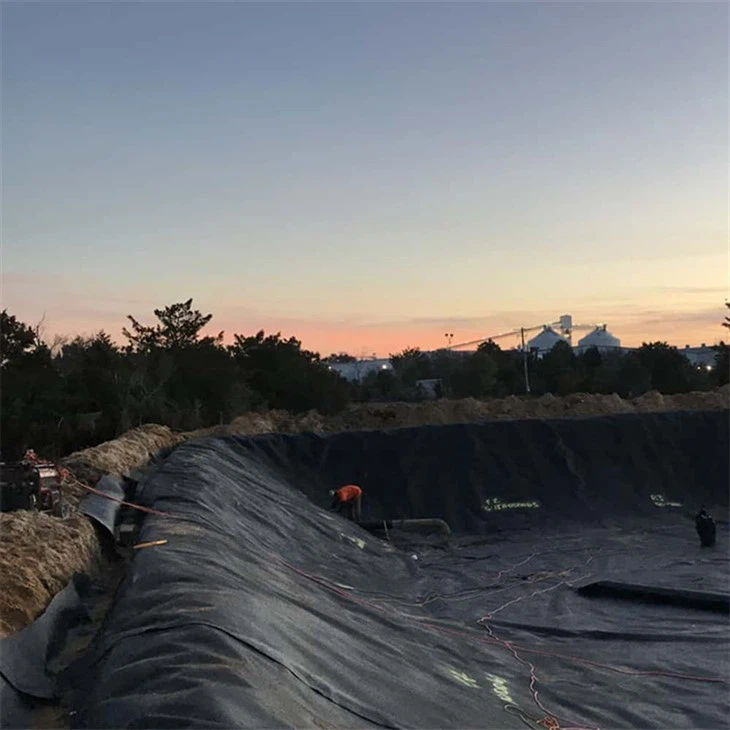
Products Description of RAS System Geomembrane Tank Liner

|
Tested Item |
Test Method |
Frequency |
Minimum Average Value |
||||
|
|
RH0.50 |
RH0.75 |
RH1.00 |
RH1.50 |
RH2.00 |
||
|
Thickness, (minimum average), mm Lowest individual reading |
ASTM D 5199 |
every roll |
0.50 0.425 |
0.750 0.675 |
1.00 0.90 |
1.50 1.35 |
2.00 1.80 |
|
Density, g/cm3 |
ASTM D 1505 |
90,000 kg |
0.940 |
0.940 |
0.940 |
0.940 |
0.940 |
|
Tensile Strength at Break, N/mm |
ASTM D 669 |
9,000 kg |
13 |
20 |
27 |
40 |
53 |
|
Tear Resistance, N |
ASTM D 1004 |
20,000 kg |
60 |
93 |
125 |
187 |
249 |
|
Puncture Resistance, N |
ASTM D 4833 |
20,000 kg |
160 |
240 |
320 |
480 |
640 |
|
Carbon Black Content, % (Range) |
ASTM D 603*/4218 |
9,000 kg |
2.0 - 3.0 |
||||
|
Carbon Black Dispersion |
ASTM D 5596 |
20,000 kg |
Note(1) |
Note(1) |
Note(1) |
Note(1) |
Note(1) |
|
Notch Constant Tensile Load, hr |
ASTM D 5397, |
90,000 kg |
300 |
300 |
300 |
300 |
300 |
|
Oxidative Induction Time, min |
ASTM D 3895, |
90,000 kg |
>100 |
>100 |
>100 |
>100 |
>100 |
Key Features & Benefit of RAS System Geomembrane Tank Liner
1. Completely sealed and leakproof
Benefits: Prevents water loss, isolates external contaminants, ensures a stable and controlled aquatic environment, and protects groundwater resources.
2. Made from high-quality virgin high-density polyethylene (HDPE)
Benefits: Provides a non-toxic, inert sealing surface that is safe for fish and shrimp, from larvae to harvest, ensuring animal health and welfare.
3. Excellent resistance to puncture, abrasion, and stress cracking
Benefits: Withstands the physical demands of RAS environments, including fish activity, cleaning, and prolonged hydrostatic pressure, ensuring long-term reliability and reducing maintenance costs.
4. Used with high-quality carbon black for excellent UV resistance
Benefits: Provides long-term durability and performance stability for indoor and outdoor tank systems, preventing polymer degradation and extending the life of the liner for decades.
5. Smooth surface for optimal hydraulic performance
Benefits: Promotes efficient water circulation, effectively drains wastewater to a central drain, supports self-cleaning tank designs, and reduces the load on filtration systems.
6. Textured, non-slip surface option
Benefits: Provides secure footing on wet surfaces, reducing the risk of slips and significantly improving safety for operators and maintenance personnel.
Applications of RAS System Geomembrane Tank Liner
1. CircularTanks for fish and Shrimp
Providing a safe, stable, and controlled environment throughout the entire growth cycle (from vulnerable larval stages to harvestable adults), ensuring optimal animal health and productivity.
2. Nursery and Hatchery Ponds
Used in sensitive larval rearing and hatchery units, the inert, non-toxic properties of the lining are crucial to protecting fragile early life stages from contaminants and stress.


3. Water Treatment and Filtration Tanks
Used in lining sumps, sedimentation tanks, and biofilters within recirculation loops, ensuring all process water is safely controlled and managed to avoid leakage or contamination.
4. Makeup Water Reservoirs and Storage Tanks
Used in lining large freshwater or brackish water storage tanks, ensuring the quantity and quality of vital make-up water supplies are maintained and protected from external contaminants.
FAQ
Q1: How thick should a fly ash geomembrane be?
A: Typically 1.5-2.5 mm; thicker thickness is recommended for high-stress applications.
Q2: Why is HDPE the preferred material for fly ash storage?
A: HDPE offers excellent chemical resistance, high tensile strength, and long-term resistance to fly ash leachate (acids, alkalis, and heavy metals).
Q3: Can HDPE geomembranes withstand the high temperatures found in fly ash ponds?
A: Yes, HDPE can withstand temperatures up to 80°C (176°F) and remains stable under typical fly ash storage conditions.
Q4: Does an HDPE geomembrane require a protective layer?
A: Yes, a non-woven geotextile (300-500 g/m²) is recommended to prevent puncture from sharp fly ash fragments.
Q5: Can an HDPE liner be repaired if damaged?
A: Yes, patches can be permanently affixed by squeeze welding or hot wedge welding.
Contact Information
Taian City Ruiheng Building Materials Co., Ltd
Address: NO.3566 Longquan Road, Tai'an Hi-tech Zone, Shandong Province, China
Website: www.rhgeos.com, www.rhgeomembrane.com
Email: lorna@rhgeos.com
Phone / Whatsapp / Wechat: 0086 187 6669 7769
Hot Tags: ras system geomembrane tank liner, China ras system geomembrane tank liner manufacturers, suppliers, factory


